Category: Money

Simple and practical insights about money habits, saving, spending, and real-life financial experiences.

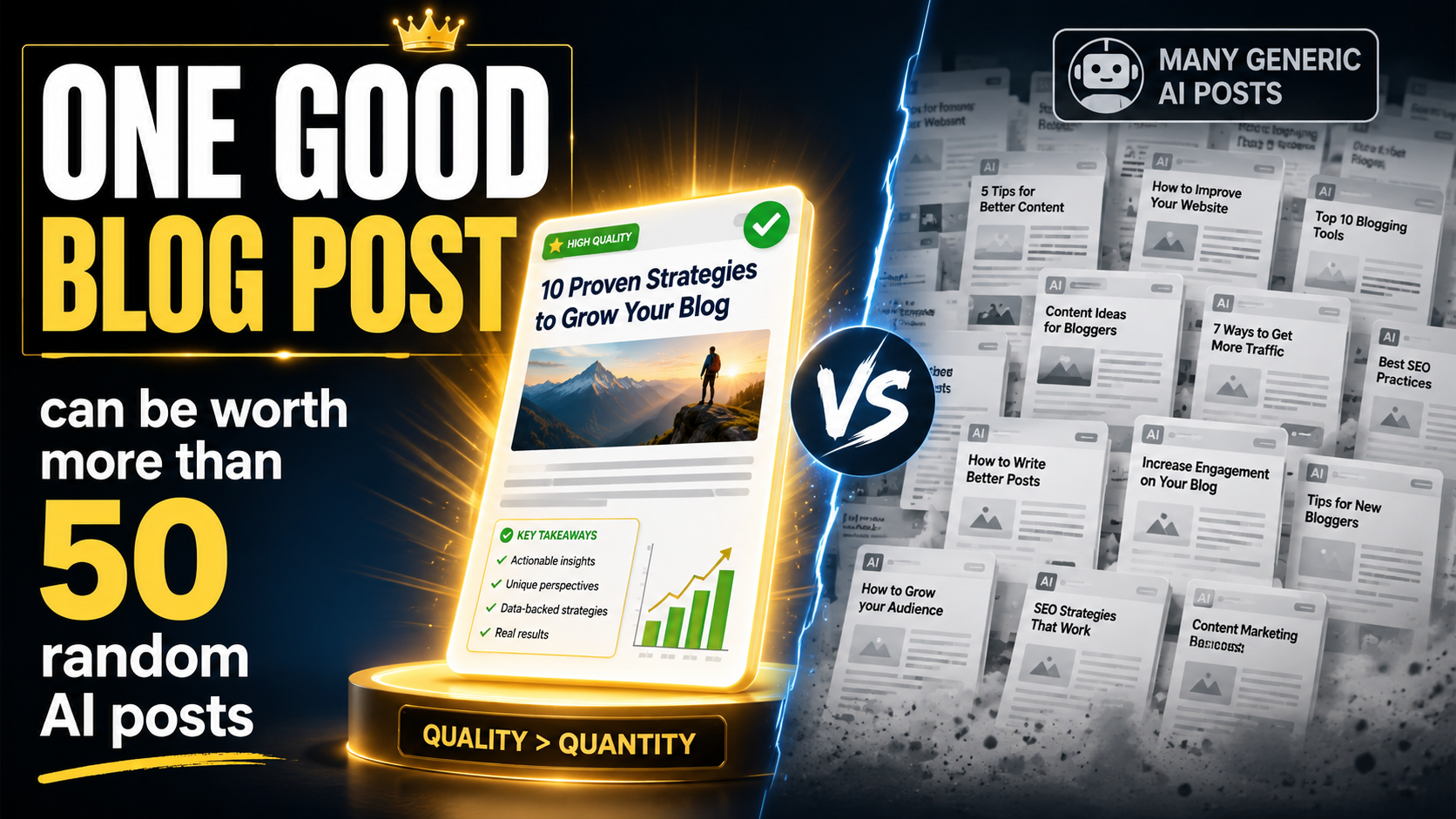
  • Why One Good Blog Post Can Be Worth More Than 50 Random AI Posts

    Why One Good Blog Post Can Be Worth More Than 50 Random AI Posts

    AI makes it very easy to create a lot of blog posts.

    In the past, writing one blog post could take hours. You had to think about the title, organize the structure, write the introduction, edit the sentences, add images, and think about SEO. But now, with AI, you can give it a topic and get a full article in just a few minutes.

    That is why many people start blogging with this idea:

    “If I write more posts, I will get more visitors.”
    “If I publish several AI posts every day, I will make money faster.”
    “Blogging is just a numbers game.”

    I thought the same thing at first.

    I once used AI to publish dozens of posts in a single day. From the outside, it looked like I was working hard. The number of posts grew quickly, and my website started to look full of content.

    But what I felt from that experience was very different from what I expected.

    I had many posts, but almost no visitors.
    I kept publishing, but people did not stay long.
    And the money did not really come.

    That was when I realized something important.

    In blogging, the number of posts is not the real point.

    A single good blog post with experience, structure, and a clear reason for readers to keep reading can be worth more than 50 random AI posts.


    Why 50 Random AI Posts Often Fail

    Writing many AI posts is not always bad.

    The problem is that many of those posts feel too similar.

    The titles may be different, but the content feels the same.
    The sentences may be clean, but there is no human feeling.
    There is information, but no experience.
    There are words, but no purpose.

    This was one of the biggest things I personally felt.

    The AI-written posts did not look terrible. The writing was clean, the topics looked useful, and the blog seemed active. But after some time, I realized that those posts did not have the power to hold people.

    A reader might feel something like this:

    “I feel like I have read this somewhere before.”
    “Has this person actually tried this?”
    “What should I do after reading this?”

    A blog post is not just a summary of information.

    This is especially true for topics like money, AI, blogging income, and online income. People do not only want methods. They want real experience, mistakes, lessons, and honest advice from someone who has actually tried it.

    What I felt is that blogging is built on trust.

    And most blog income starts from trust.


    One Good Post Keeps Readers Longer

    A good blog post is not just a long article.

    A good blog post feels like it understands the reader.
    A good blog post explains the real problem clearly.
    A good blog post gives the reader a next step.

    For example, imagine writing an article about “how to make money with AI.”

    A basic AI article may say something like this:

    Use AI to write blog posts.
    Create digital products.
    Try affiliate marketing.
    Make YouTube videos.
    Sell online courses.

    These ideas are not wrong.

    But they are too general.

    A better post feels different.

    It might say:

    “I also thought AI would help me make money if I simply published more posts. So I tried posting dozens of AI-written articles in one day. But nobody came to read them. That was when I felt that AI was not the real problem. The problem was that my posts had no experience and no structure.”

    That kind of writing feels different.

    It does not sound like simple information.
    It sounds like someone who has actually been through the process.

    Readers stay longer because they are not only reading facts. They are reading a real experience.


    What I Felt: The Reason Behind the Post Matters More Than the Number of Posts

    The biggest thing I felt after publishing many AI posts was this:

    Even if you have many posts, people will not come if they do not have a real reason to read them.

    At first, I thought publishing more posts was proof that I was working hard. When I published several posts a day, it felt like my blog was growing. When I looked at the number of posts in my dashboard, I felt like I was doing something right.

    But the visitor numbers did not move in the same way.

    That feeling was frustrating.

    “I am working hard, so why is nobody coming?”
    “I have so many posts, so why is there no income?”
    “I thought AI would make this easier, so why is nothing happening?”

    After that, my thinking changed.

    A blog is not just a place to store many articles.
    A blog is a place where readers come to solve a problem.

    The important thing is not only how many posts you have.
    The important thing is why a reader should read that post.

    After I felt this, I stopped trying to increase the number of posts blindly. Instead, I started focusing on making one article more useful, more honest, and more connected to the reader’s real problem.

    Before focusing only on writing more posts, it helps to understand why most AI blogs don’t make money and why structure matters more than speed.


    One Good Blog Post Can Become Several Income Paths

    One good blog post does not have to end as just one post.

    A strong article can grow into several income paths.

    For example, imagine an article called “Why Most AI Blogs Don’t Make Money.” This kind of article can include more than basic information. It can talk about why AI blogs fail, personal experience, the importance of a system, internal links, and monetization structure.

    That type of post can connect to income in several ways.

    First, it can support ad revenue.
    If the article is useful and readers stay longer, there are more chances for ad impressions.

    Second, it can connect to internal links.
    Readers can move from one article to another.

    Third, it can support affiliate links.
    You can naturally mention AI tools, blogging tools, hosting services, or email marketing tools.

    Fourth, it can become a PDF or checklist.
    For example, you could turn the idea into an “AI Blog System Checklist.”

    Fifth, it can connect to an email list.
    If people like the article, they may want more similar content.

    This is what I felt about the value of a good post.

    One good post can become a small income hub.

    But 50 random AI posts often stay separate from each other. They are not connected. They do not lead to income. They do not guide the reader to the next step.


    A Good Post Is Easier for Search Engines to Understand

    Google does not only look at the number of posts on a website.

    It also tries to understand whether a site covers a topic deeply, whether the articles are connected, and whether the content gives real value to readers.

    Fifty random AI posts can actually make a site weaker.

    The topics may become too scattered.
    The content may feel too thin.
    The same ideas may repeat again and again.

    This is another risk I felt with AI blogging.

    When you publish many posts, the site looks bigger.
    But if the posts have no direction, the site can become confusing.

    A good post can become the center of the website.

    For example, a post like “Why One Good Blog Post Can Be Worth More Than 50 Random AI Posts” can connect blogging, AI writing, monetization, and content strategy.

    Inside that post, you can naturally link to other useful articles.

    You can link to an article about why AI blogs fail.
    You can link to an article about how to write AI blog posts that make money.
    You can link to an article about affiliate income.
    You can link to an article about AdSense and blog quality.

    This helps both readers and search engines understand the flow of the website.


    Before Writing Many Posts, Make One Strong Post First

    One of the most common mistakes beginners make is trying to publish too many posts too quickly.

    Of course, consistency is important.

    But consistency without direction does not create strong results.

    What I felt is that a better order is this:

    First, create one strong blog post properly.

    That post should include:

    the reader’s problem
    your real experience
    the reason behind the problem
    a practical solution
    internal links to related posts
    a possible path to monetization
    a clear next step for the reader

    When you create one post like this, the next posts become easier to connect.

    One strong post becomes the center, and other posts can support it.

    That is what a blog system means to me.

    The articles are not separate pieces.
    They are connected as one flow.


    AI Is Not Just a Tool for Writing More

    AI can help you write faster.

    But fast writing does not always mean good writing.

    AI is useful for making drafts.
    It is useful for organizing ideas.
    It is useful for improving sentences.
    It can also help with SEO structure.

    But the final value of the post still comes from the person.

    Adding your experience
    Understanding the reader’s feelings
    Being honest about failure
    Deciding the purpose of the article
    Connecting the post to an income structure
    Linking it to the next article

    AI does not automatically do these things well.

    What I felt is that AI is not a tool that magically makes money for you. It is more like a tool that helps you organize your thoughts faster.

    AI is a tool.

    But the direction of the blog still has to come from a person.

    That is why using AI to create one strong article is more important than using AI to publish many weak articles.


    Conclusion: One Strong Post Comes Before 50 Random Posts

    Beginner bloggers often focus too much on the number of posts.

    I did the same thing.

    I thought that if I used AI to publish dozens of posts in one day, my blog would grow faster.

    But what I felt in reality was different.

    Fifty posts that nobody reads are not more valuable than one post that people actually read, trust, and continue from.

    One good post can become the center of a blog.
    One good post can become the starting point for internal links.
    One good post can connect to ad revenue, affiliate income, email signups, and PDF products.
    One good post can give direction to the whole website.

    In the AI era, anyone can create many articles.

    So the important skill is no longer just creating more content.

    The important skill is creating better content and connecting that content to a real system.

    What I learned from trying AI blogging is simple:

    AI can help you write more.

    But human experience is what makes people want to read.

    That is why one good blog post can be worth more than 50 random AI posts.
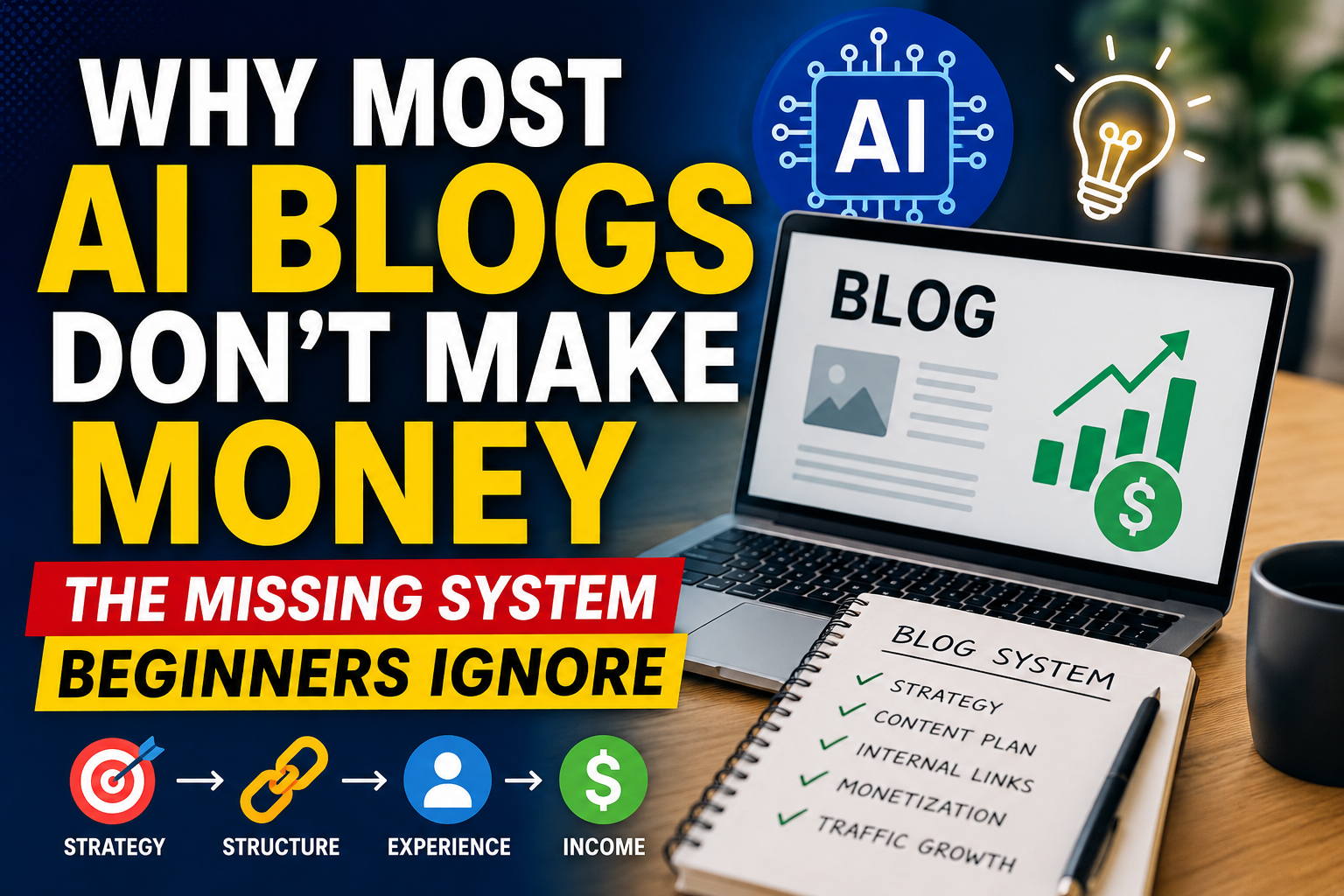
  • Why Most AI Blogs Don’t Make Money: The Missing System Beginners Ignore

    Why Most AI Blogs Don’t Make Money: The Missing System Beginners Ignore

    AI has made blogging look easier than ever.

    A few years ago, writing a blog post could take hours. You had to think of the title, plan the structure, write the introduction, organize the ideas, edit the sentences, and then prepare everything for publishing.

    Now, with AI, one blog post can be created in minutes.

    That sounds powerful. And honestly, it is powerful.

    But there is one problem many beginners do not see at first.

    AI can help you write faster, but writing faster does not automatically mean making money faster.

    This is where many AI blogs fail.

    A lot of people start a blog with excitement. They use AI tools to create many articles. They publish post after post. At first, it feels like real progress. The website begins to look full. The archive grows. The number of published posts increases.

    But after a while, reality becomes uncomfortable.

    The posts are there.
    The website is active.
    The content is published.

    But the visitors do not come.

    And even if a few visitors come, the money does not follow.

    That is when many beginners start to ask the real question:

    “Why is my AI blog not making money?”

    The answer is usually not because AI is bad.

    The answer is usually because the blog has no system.


    I Also Thought Posting More AI Articles Would Be Enough

    I understand this mistake because I made it too.

    When I first started using AI for blogging, I thought the biggest advantage was speed.

    Before AI, writing one article took time. But with AI, I could create content much faster. I could come up with topics, generate outlines, write drafts, and publish articles much more quickly than before.

    At one point, I even tried publishing dozens of AI-written posts in a single day.

    My thinking was simple.

    If I publish more posts, more people will find my blog.
    If more people find my blog, traffic will grow.
    If traffic grows, money will come.

    It sounded logical.

    But the result was very different from what I expected.

    The posts kept increasing, but almost nobody came to read them.

    My website looked busy from the outside, but the reality was empty. I had more content, but not more readers. I had more pages, but not more trust. I had more words, but not more income.

    That experience taught me something important.

    The problem was not only the number of posts.

    The problem was that most of those posts had no real personal experience inside them. They looked clean. They had titles. They had paragraphs. They had information.

    But they did not feel like they came from a real person who had tried, failed, learned, and changed.

    So I changed my approach.

    Instead of trying to publish as many posts as possible, I started writing from experience. I wrote about what actually happened when I used AI to create content. I wrote about the disappointment of publishing many articles and still getting no traffic. I wrote about the mistake of thinking that quantity alone would create income.

    And something changed.

    I did not need to publish as many posts as before, but visitors slowly started to increase.

    The articles with real experience performed better than the generic articles. People seemed to spend more time on them. The writing felt more honest. The content had a reason to exist.

    That is when I realized something important about AI blogging.

    People do not only want information.

    They want information from someone who has actually been through the problem.

    AI can help you write faster, but AI cannot live your life for you. It cannot feel the frustration of publishing articles that nobody reads. It cannot experience the disappointment of earning nothing after working hard. It cannot explain your personal lessons unless you bring those lessons into the article.

    That is why human experience matters so much.


    AI Can Create Content, But It Cannot Create a Business System for You

    AI is useful.

    It can help with titles.
    It can help with outlines.
    It can help with SEO ideas.
    It can help rewrite weak sentences.
    It can help organize messy thoughts.

    But AI does not automatically turn your blog into a business.

    This is where many beginners misunderstand blogging.

    They think the process is simple:

    Write articles.
    Get traffic.
    Make money.

    But real blogging is not that simple.

    A blog that earns money usually has a system behind it.

    A visitor finds one article.
    The article answers a real question.
    The visitor trusts the site.
    The visitor reads another article.
    The visitor clicks an internal link.
    The visitor sees an ad.
    The visitor clicks an affiliate link.
    The visitor joins an email list.
    The visitor may later buy a guide, PDF, tool, or service.

    That is a system.

    The article itself is only one part of the structure.

    But many AI blogs are just collections of disconnected posts. Each article stands alone. One post does not lead to another. There is no clear path for the reader. There is no next step. There is no trust-building process.

    So even if the blog has many posts, it does not work like a money-making system.

    It works like a warehouse full of articles.

    And a warehouse does not make money just because it is full.

    Once you understand why most AI blogs fail, the next step is learning how to use AI to write blog posts that can actually make money.


    More Content Does Not Always Mean More Income

    One of the biggest mistakes beginners make is thinking that more content always means more income.

    It does not.

    More useful content can help.
    More targeted content can help.
    More experience-based content can help.

    But more generic content usually does not help much.

    For example, imagine someone publishes ten AI-written blog posts every day.

    The titles look good.
    The paragraphs are clean.
    The keywords are included.
    The structure looks professional.

    But the articles all feel similar.

    There is no personal story.
    There is no original point of view.
    There is no clear reader journey.
    There is no internal link strategy.
    There is no reason for the reader to stay longer.
    There is no clear way for the article to make money.

    That kind of blog may look active, but it is weak.

    Readers today do not need another basic explanation. The internet is already full of basic explanations.

    People want something more specific.

    They want to know:

    Has this person actually tried this?
    What went wrong?
    What did they learn?
    What should I avoid?
    What should I do next?
    Can I trust this person?

    This is where generic AI content often fails.

    AI can summarize information, but it cannot replace lived experience.

    It has never stayed up late wondering why traffic is not growing.
    It has never checked AdSense earnings and felt disappointed.
    It has never published many posts and watched nobody read them.
    It has never felt the small excitement of getting the first real visitor.

    That human side matters.

    Without it, a blog can feel empty even when it has many articles.


    Most AI Blogs Have No Reader Flow

    A money-making blog needs reader flow.

    This means the reader should not land on one article and then leave immediately. The blog should guide the reader naturally from one useful page to another.

    For example, someone may first read an article called:

    “How to Make Money With AI”

    After reading that article, the person may have more questions.

    Can beginners really do this?
    Is blogging a good way to start?
    How do I write AI blog posts?
    Why do some AI blogs fail?
    How do I add affiliate links?
    How does AdSense work?
    Can I turn one blog post into multiple income streams?

    A good blog answers these questions through connected articles.

    One post leads to another.
    One topic supports another.
    One article builds trust for the next article.

    That is how the blog becomes a system.

    But many AI blogs do not have this structure.

    The posts are not connected. The visitor reads one article and leaves. There is no internal link to a related topic. There is no suggestion for what to read next. There is no reason to continue.

    This hurts the blog in two ways.

    First, readers do not stay long.

    Second, Google may have a harder time understanding the structure and purpose of the site.

    A blog should not feel like random articles placed together.

    It should feel like a guided path.


    A Profitable Blog Needs a Purpose for Every Article

    Every article on a money-making blog should have a job.

    Some articles bring in new visitors.
    Some articles build trust.
    Some articles explain a problem.
    Some articles compare options.
    Some articles recommend tools.
    Some articles lead to affiliate income.
    Some articles support email signups.
    Some articles help AdSense revenue by increasing time on site.

    But many AI blog posts have no clear job.

    They are just “content.”

    That is not enough.

    A blog post should not only ask, “What keyword can I target?”

    It should also ask:

    Who is this article for?
    What problem does it solve?
    What should the reader do after reading it?
    Which article should this post link to?
    Can this article lead to an affiliate product?
    Can this article support an email list?
    Can this article help build trust for a future product?

    Without purpose, a blog post becomes passive.

    It may exist on the website, but it does not move the reader anywhere.

    And if the reader does not move, money usually does not move either.


    Beginners Should Build the Structure Before Publishing Too Much

    Many beginners do blogging in the wrong order.

    They write many articles first.
    Then later, they try to figure out how to make money.

    A better way is to think about the structure first.

    Before publishing too many posts, ask these questions:

    What is my blog really about?
    Who am I writing for?
    What problem does my reader have?
    What is the first article they should read?
    What should they read next?
    Where should the blog eventually lead them?
    Will I use AdSense only?
    Will I use affiliate links?
    Will I build an email list?
    Will I create a PDF, guide, or digital product later?

    These questions are not small details.

    They are the foundation.

    If you skip them, you may end up with a blog full of articles that do not work together.

    I learned this from experience.

    Writing many posts is easy with AI.
    Building a blog that actually makes sense is harder.

    AI gives speed.

    But the direction still has to come from you.


    The 5 Systems an AI Blog Needs to Make Money

    If you want an AI-assisted blog to make money, you need more than articles.

    You need systems.

    1. A Clear Topic

    Your blog needs a clear direction.

    If your site talks about AI income, saving money, blogging, digital products, and simple living, that can still work. But the connection must be clear.

    For example, the main idea could be:

    Helping ordinary people save money, use AI wisely, and build simple online income streams.

    That gives the blog a direction.

    If the topics feel too random, both readers and Google may struggle to understand what your site is about.

    2. Internal Links

    Internal links are important because they connect your content.

    If one article explains the truth about making money with AI, another article can explain how to write AI blog posts. Another can explain why AI blogs fail. Another can explain affiliate links or AdSense.

    These posts should not stand alone.

    They should support each other.

    Internal links help readers stay longer and help search engines understand your website better.

    3. Real Experience

    This is one of the most important parts.

    AI can create a draft, but you should add your own experience.

    What did you try?
    What failed?
    What surprised you?
    What would you do differently?
    What advice would you give to a beginner?

    This makes the article more trustworthy.

    It also makes the article harder to replace.

    Anyone can ask AI to write a generic article. But nobody else has your exact experience.

    4. Monetization Points

    A blog needs places where money can actually happen.

    This may include:

    AdSense ads
    affiliate links
    email signup forms
    downloadable PDFs
    simple guides
    digital products
    recommended tools
    services

    Not every article needs to sell something. But the overall blog should have a path toward income.

    If there is no monetization point, the blog may get traffic but still earn very little.

    5. Regular Updating

    Blogging is not only publishing.

    It is also improving.

    You may need to update old titles.
    Add better examples.
    Improve weak introductions.
    Add internal links.
    Remove thin content.
    Rewrite AI-sounding parts.
    Add more personal experience.

    A blog is not finished after publishing.

    A blog grows through editing.

    This is especially true for AI content because the first draft often sounds too general. The real value comes when you improve it with human judgment and experience.


    AI Is a Tool, Not the Whole Business

    This article is not saying AI is useless.

    AI is very useful.

    For beginners, AI can reduce the fear of writing. It can help organize ideas. It can speed up content creation. It can suggest topics and improve structure.

    But AI should not replace your thinking.

    AI should help you write.
    It should not decide your whole strategy.

    AI can create a draft, but you should add the story.
    AI can suggest keywords, but you should understand the reader.
    AI can organize information, but you should build the system.
    AI can speed up the work, but you should decide the direction.

    The best AI blogs are not blogs where AI does everything.

    The best AI blogs are blogs where a real person uses AI as a tool and then adds experience, judgment, and structure.

    That is the difference.


    Conclusion: AI Blogs Fail Because They Lack a System

    Most AI blogs do not fail because AI is bad.

    They fail because they have no system.

    They have articles, but no structure.
    They have content, but no reader flow.
    They have information, but no experience.
    They have traffic goals, but no monetization path.
    They have publishing speed, but no clear direction.

    I learned this the hard way.

    I once thought that publishing dozens of AI-written posts in a day would help my blog grow. But when nobody came to read them, I realized that quantity alone was not enough.

    When I started adding real experience, the blog became more useful. I did not need to publish as much as before. The articles became more focused. The content felt more honest. Visitors slowly started to increase.

    That is why beginners should not only ask, “How can I write more articles with AI?”

    They should ask better questions.

    Who is this article for?
    What problem does it solve?
    What should the reader read next?
    Where does this article fit inside my blog?
    How can this content eventually support income?
    What personal experience can I add that AI cannot create by itself?

    AI can help you write faster.

    But speed alone does not build a profitable blog.

    A profitable blog needs structure, trust, experience, and a clear path.

    AI can create the words.

    But the system still has to come from you.

  • AI Money Series 3:How to Use AI to Write Blog Posts That Can Actually Make Money

    AI Money Series 3:How to Use AI to Write Blog Posts That Can Actually Make Money

    One of the most realistic ways for beginners to make money with AI is blogging.

    YouTube can feel difficult because you may need to show your face, record your voice, edit videos, and create thumbnails.
    Selling ebooks can feel hard if you do not have a product yet.
    Freelancing can also feel difficult because you need clients, platforms, and competition can be strong.

    But blogging is a quieter way to start.

    You can write articles, add images, target search keywords, and slowly connect your blog to advertising, affiliate links, digital products, or an email list.

    That is why blogging is still a good starting point in the AI era.

    But there is something very important to understand.

    Writing blog posts with AI does not automatically create money.

    AI can help you write faster.
    But a money-making blog post is not just a fast article.

    It needs to be something people search for, click on, read, trust, and continue exploring. It should also guide readers toward another helpful article, an ad impression, an affiliate link, a digital product, or an email signup.

    In other words, if you want to make money with AI blogging, writing is only one part of the process.

    The real goal is to place each article inside an income structure. <!–more–>

    AI Makes Blog Writing Easier to Start

    The hardest part of blogging is often the blank page.

    You do not know what title to use.
    You do not know how to start the first sentence.
    You may have an idea, but you do not know how to organize it.
    Even if you start writing, the flow can break in the middle.

    AI can help a lot with this.

    You can give AI a topic and ask for title ideas.
    You can give AI a title and ask for an outline.
    You can give AI an outline and ask for a first draft.
    You can give AI a rough paragraph and ask it to make the writing clearer.
    You can write in your own language and ask AI to help turn it into English.

    In the past, writing one article could take a long time.

    Now, with AI, you can at least create a first draft much faster.

    That is a major advantage.

    Blogging usually does not work with only one article.
    You need multiple articles.
    Those articles need to build on each other.
    They need to be connected.
    They need time to appear in search results.
    Over time, they can become online assets.

    AI helps with the first step.

    But you should not stop there.

    Publishing an AI draft without adding your own thinking is usually not enough.

    A Money-Making Blog Post Needs Clear Search Intent

    When writing a blog post, the first question should not be only, “What do I want to write?”

    Your experience and ideas are important, but if you want to make money from blogging, you also need to think about what people are actually searching for.

    For example, “AI is useful” is too broad.

    But these topics are more specific:

    How to write blog posts with AI
    How to start an English blog with AI
    How to create a PDF ebook with AI
    How to start a side hustle with AI
    How to turn one article into multiple content pieces
    What beginners should know before making money with AI

    These topics have clearer search intent.

    People searching for these topics are not just curious about AI.
    They want to start something.
    They want a method.
    They want a practical answer.

    That is why you need to think about the reader’s intention before writing.

    Why did this person search this keyword?
    What problem are they trying to solve?
    What do they expect to learn?
    What should they be able to do after reading the article?

    A blog post becomes stronger when it answers those questions.

    AI can write words.

    But you need to understand the search intent.

    Do Not Ask AI to “Just Write an Article”

    Many beginners make the same mistake.

    They ask AI something like this:

    “Write an article about making money with AI.”
    “Write a blog post about blog monetization.”
    “Write an article about side hustles.”

    AI will write something.

    But the result is often too general.

    It may not have a clear audience.
    It may sound like many other articles online.
    It may have information, but not enough personality or direction.

    To create a better article, do not ask AI to write immediately.

    Give AI better material first.

    For example, you can say:

    My reader is a beginner.
    They are not confident in English, but they want to start a blog for an American audience.
    They want to use AI to write articles, but they do not want the content to sound too robotic.
    I have personally tried producing many AI articles, but I learned that mass production alone does not make money.
    I want the article to explain that personal experience and a human voice matter.
    Based on this, create a blog post outline.

    This kind of instruction gives AI direction.

    AI is smart, but it does not know your real experience.
    It does not know your audience unless you explain it.
    It does not know the purpose of your article unless you give that purpose clearly.

    Think of AI like a cook.

    If the ingredients are weak, the result will be ordinary.
    If the ingredients are specific, the result can become much better.

    You Must Add Your Own Experience to the AI Draft

    An AI-generated article can look good at first.

    The sentences may be clean.
    The structure may be organized.
    The ideas may seem useful.

    But if you publish it exactly as it is, there can be a problem.

    Many AI-written articles feel similar.

    AI is good at organizing general information.
    But it is not good at replacing real emotion, failure, struggle, and personal lessons.

    For example, AI can say, “Be consistent with blogging.”

    But someone who has actually tried blogging can say something much more real.

    In the beginning, you may write many articles and still get almost no visitors.
    It can feel disappointing.
    It takes time for search engines to notice your content.
    When you write a lot but make no money, you may start wondering if you are doing everything wrong.
    If you only mass-produce AI content, the blog may have many articles but still fail to keep readers.

    That kind of writing comes from experience.

    Readers stay longer when they feel the writer has actually lived through the problem.

    An AI draft is the skeleton.
    Your experience is the body.
    Your lesson is the strength of the article.

    That is why you should always add your own experience when using AI for blog writing.

    Add what you tried.
    Add what failed.
    Add what surprised you.
    Add what was harder than expected.
    Add what you would do differently now.

    This is what makes the article feel human.

    One Blog Post Usually Does Not Make Money Alone

    Many beginners write one article and expect results immediately.

    But blog income usually does not come from one isolated article.

    Articles need to be connected.

    For example, this article is about using AI to write blog posts.

    It can connect to other articles such as:

    The truth about making money with AI
    How to create PDF ebooks with AI
    How to make YouTube Shorts scripts with AI
    How to start an English blog with AI
    How to turn one piece of content into multiple income opportunities

    When articles are connected, readers do not leave after one post.

    They read another article.
    They spend more time on the site.
    Search engines can understand your blog structure more clearly.
    Ad impressions may increase.
    Affiliate links or digital product opportunities may become more natural.

    That is why you should think of a blog as a structure, not just a collection of separate posts.

    AI can help you create one article faster.

    But you need to design the whole flow.

    Which article brings new readers in?
    Which article builds trust?
    Which article connects to a product or affiliate link?
    Which article should lead to the next article?

    A blog becomes more powerful when the articles work together.

    AI-Written Posts Must Be Edited to Sound Human

    One weakness of AI writing is that it can sound too clean.

    That may sound strange, but it is true.

    Human writing is not always perfect.
    Sometimes it has a natural flow, emotion, hesitation, and personal expression.

    AI writing can be too polished, too balanced, and too predictable.

    So after AI creates a draft, you need to edit it.

    If the sentence sounds too formal, make it more natural.
    If the advice is too general, add a specific example.
    If the section feels empty, add a real experience.
    If the same idea repeats too often, remove it.
    If the article feels like a textbook, bring it closer to real life.

    For example, this sentence is weak:

    “You need to be consistent.”

    This is better:

    When you first start blogging, you may publish for days or weeks and see almost no reaction. That is when many people quit. But blogging takes time because search engines need time to find, understand, and rank your content. The quiet beginning is part of the process.

    The second version feels more real.

    Making AI writing human is not just about changing words.

    It is about adding reality.

    Readers need to feel, “This person has actually tried this.”

    Write With Monetization in Mind

    If you think only about money, your blog post may start to sound like an advertisement.

    That is not good.

    Readers can feel it when a post exists only to sell something.

    But if you never think about monetization, that is also a problem.

    Before writing a post, think about the role of that article.

    Is this article for search traffic?
    Is it for building trust?
    Is it for connecting to another article?
    Can it naturally include an affiliate link?
    Can it become a future PDF product?
    Can it lead to an email signup?

    For example, an article about writing blog posts with AI can connect to many income paths.

    It can connect to AI writing tools.
    It can connect to a blogging guide.
    It can connect to a PDF template.
    It can connect to an email list.
    It can connect to another article in the same series.

    But the article should help the reader first.

    Do not start by selling.

    Start by solving a problem.

    If the reader trusts the article, links become more natural.
    If the article feels useful, the reader is more likely to click, subscribe, or return later.

    Blog monetization begins with trust.

    AI can help you write faster.

    But trust comes from experience, honesty, and consistency.

    Beginners Should Focus on Building, Not Perfection

    Many beginners get stuck because they want every article to be perfect.

    The title must be perfect.
    The introduction must be perfect.
    The image must be perfect.
    The SEO must be perfect.
    The whole article must feel complete before they publish.

    Quality matters, of course.

    But perfection can stop you from publishing.

    A blog post can be improved later.
    You can change the title later.
    You can add internal links later.
    You can update the image later.
    You can rewrite the meta description later.
    You can improve the article after seeing how it performs.

    The important thing is to publish, observe, and improve.

    AI makes this easier because you can update content faster.

    You can ask AI for better title options.
    You can rewrite a weak section.
    You can improve a meta description.
    You can make subheadings more search-friendly.
    You can add FAQs later.

    So beginners should not aim for perfect content from day one.

    Aim for useful content.
    Publish it.
    Improve it over time.

    But do not confuse this with low-quality mass production.

    You still need experience, clarity, and human feeling.

    If you want to write more blog posts faster, you can also read my guide on how to use AI to write blog posts that can actually make money.

    Final Thoughts: AI Is a Blogging Tool, Not a Complete Business

    AI can make blog writing much easier.

    It can help with ideas, titles, outlines, drafts, editing, English writing, and SEO preparation.

    But AI does not automatically make a blog profitable.

    A blog post that can actually make money needs clear search intent.
    It needs to solve a reader’s problem.
    It needs your experience.
    It needs internal links.
    It needs a monetization path.
    It needs to feel human.

    Writing many posts with AI is only the beginning.

    The real work is deciding the direction, adding experience, connecting the articles, and building a structure.

    AI can create a draft.

    But a human creates trust.

    AI can help you write faster.

    But readers stay because of real experience.

    AI is a powerful tool for blogging.

    But the tool alone does not make money.

    The person using the tool must bring direction, experience, consistency, and structure.

  • The Truth About Making Money With AI: Why AI Alone Is Not Enough

    The Truth About Making Money With AI: Why AI Alone Is Not Enough

    Making money with AI has become one of the most popular topics online.

    You can see it everywhere.

    “Make money with AI in one day.”
    “Build passive income with AI.”
    “Use AI to create an online business.”
    “Let AI write for you and start earning money.”
    “Beginners can make money online with AI.”

    At first, it sounds very exciting.

    It feels like you can type a few words into an AI tool, get a blog post, create an image, build an ebook, publish something online, and start earning money.

    But the real world is not that simple.

    AI is powerful.
    AI can help you write faster.
    AI can help you organize ideas.
    AI can help you create blog posts, product descriptions, video scripts, captions, emails, outlines, and digital product ideas.

    But using AI does not mean you will automatically make money.

    In fact, many beginners may misunderstand AI because the results appear so quickly.

    A blog post can be created in minutes.
    A title can be generated instantly.
    An ebook outline can appear in seconds.
    A thumbnail idea can be written almost immediately.

    So people start to think, “If I can create this much content so quickly, I should be able to make money soon.”

    But money does not come simply because content exists.

    Money comes when people care, read, trust, click, subscribe, buy, or come back again.

    That is the reality many beginners need to understand before trying to make money with AI. <!–more–>

    AI Makes Starting Easier, But It Does Not Guarantee Success

    The biggest advantage of AI is that it makes starting easier.

    Before AI became common, even writing one blog post could feel difficult.

    You had to think of a title.
    You had to decide the structure.
    You had to write the opening.
    You had to organize your thoughts.
    You had to make the article clear enough for readers.

    If you wanted to create an ebook, you had to plan the chapters.
    If you wanted to write in English, you needed language skills.
    If you wanted to create social media posts, you needed short and attractive captions.

    Many people stopped before they even started.

    Now, AI can help with those first steps.

    It can organize your ideas.
    It can create an outline.
    It can draft an article.
    It can improve your English.
    It can write product descriptions.
    It can suggest social media captions.

    That is a real opportunity.

    But there is a big difference between making the start easier and guaranteeing success.

    AI can help you write a blog post, but it cannot force people to read it.
    AI can help you create an ebook, but it cannot make people buy it.
    AI can help you add affiliate links, but it cannot guarantee clicks or commissions.

    AI lowers the starting line.
    But it does not run the whole race for you.

    You still have to decide your topic.
    You still have to understand your audience.
    You still have to add real experience.
    You still have to publish consistently.
    You still have to build a system that can actually earn money.

    That part still belongs to the person using AI.

    The Biggest Trap Is Believing in “Automatic Income”

    One of the most dangerous ideas in the AI era is the idea of automatic income.

    Of course, automation is possible.

    A blog post can be scheduled.
    Emails can be sent automatically.
    Digital products can be delivered automatically.
    Ads can generate income when people visit your site.
    Affiliate links can work even when you are not online.

    But there is something important behind all of that.

    Before something becomes automatic, a system must exist first.

    You need content.
    You need traffic.
    You need trust.
    You need a reason for people to stay.
    You need links that make sense.
    You need products people actually want.
    You need a clear path from content to income.

    Automatic income is not automatic in the beginning.

    At the start, you need to work.

    You need to write.
    You need to edit.
    You need to publish.
    You need to check what works.
    You need to improve old posts.
    You need to create internal links.
    You need to test your income structure.

    Many beginners skip this part and only dream about passive income.

    But the truth is the opposite.

    AI can help you create faster, but the money system is usually built slowly.

    Real Experience Matters More as AI Content Increases

    The internet is going to be filled with more AI-generated content.

    Actually, it is already happening.

    Many blog posts, product descriptions, social media captions, emails, and video scripts are now created with the help of AI.

    So what happens next?

    Generic information becomes less valuable.

    Why?

    Because anyone can create it.

    An article about “10 ways to save money” can be created by AI.
    An article about “how to make money with blogging” can be created by AI.
    An article about “AI side hustle ideas” can also be created by AI.

    The problem is that many of these articles feel similar.

    They may be clean.
    They may be organized.
    They may include useful points.

    But they often do not feel memorable.

    They have information, but they do not have enough human feeling.
    They have structure, but they do not have real weight.
    They sound correct, but they do not always feel lived.

    That is why real experience becomes more important in the AI era.

    I learned this from my own experience.

    When I first started using AI to write, I thought creating many articles would eventually bring results.

    I produced a lot of content with AI.

    Compared to the past, I could create articles much faster.
    I could generate titles, write drafts, prepare thumbnail text, and build content ideas quickly.

    At first, it felt like a huge opportunity.

    I thought, “If I can create content this fast, I can publish a lot.”
    And I thought, “If I publish a lot, traffic will come, and money will follow.”

    But after actually trying it, I realized the reality was different.

    A large number of articles does not automatically create income.

    AI-generated articles can look good.
    The sentences can be clean.
    The structure can be organized.
    The information can seem useful.

    But something can still be missing.

    Many of my AI-written articles felt too similar.
    They did not have enough personality.
    They did not have enough human experience.
    They did not have the kind of emotional weight that makes a reader stay.

    That was when I realized something important.

    AI can write, but AI cannot truly replace the weight of real experience.

    AI has never struggled with money.
    AI has never felt the fear of losing money in a bad investment.
    AI has never experienced the stress of having no cash available when life becomes difficult.
    AI has never started a blog and felt disappointed because almost nobody visited.
    AI has never published many articles and felt nervous because no money came in.

    Those feelings come from real life.

    Those lessons come from real experience.

    That is why making money with AI is not about producing endless content.

    It is about using AI as a tool and then adding your own failures, thoughts, emotions, mistakes, and lessons.

    Readers do not always stay because a post is perfectly organized.

    They stay because they feel there is a real person behind the words.

    AI can create sentences.
    But the pain, frustration, lessons, and strength that come from real experience must come from a human being.

    Now I see AI differently.

    AI should not replace my voice.
    AI should help me organize my voice.

    AI can create the structure.
    But I have to add the experience.
    AI can prepare the draft.
    But I have to add the human lesson.

    That is when an AI-assisted article becomes real content.

    Mass-Producing AI Content Can Be Dangerous

    AI makes it easy to create a lot of content.

    That is useful.

    But it can also be dangerous.

    When beginners see how fast AI can write, they often want to publish as much as possible.

    They may think, “If I publish more articles, I will grow faster.”
    And sometimes, consistency does matter.

    But quantity alone is not enough.

    Quality matters.

    If you publish AI-generated drafts without editing them, the writing can become too general.
    The examples may sound similar.
    The conclusions may feel predictable.
    The voice may feel flat.

    At first, publishing many articles may feel productive.

    But search engines and readers both want useful content.

    A good article is not just a long article.

    A good article gives readers a reason to keep reading.

    It includes real examples.
    It solves a clear problem.
    It has a specific point of view.
    It feels honest.
    It connects to another useful resource.
    It gives the reader something they can remember.

    That is why editing matters.

    AI can create the first draft.
    But you need to shape the direction.
    You need to remove weak parts.
    You need to add real examples.
    You need to make the tone feel natural.
    You need to make the article useful for a real person.

    Mass-producing AI content without human editing will become harder and harder.

    The internet does not need more empty content.

    It needs useful, honest, experience-based content.

    Money Comes From Structure, Not Just Content

    Many people think that writing blog posts will automatically create money.

    But content alone does not usually create income.

    Content brings attention.

    The money usually comes from the structure behind the content.

    For example, someone visits your blog.
    They read one article.
    Then they click another related article.
    They stay longer.
    They see ads.
    They click an affiliate link.
    They subscribe to your email list.
    Later, they buy a digital product or use a recommended service.

    That is an income structure.

    AI can help you create content, but you still need to design the structure.

    You need internal links.
    You need related articles.
    You need a clear category system.
    You need useful products or affiliate offers.
    You need a reason for people to come back.

    For example, if you write about making money with AI, that article can connect to other topics such as:

    how to write blog posts with AI,
    how to create PDF products with AI,
    how to make short video scripts with AI,
    how to start freelance work with AI,
    and how to turn one piece of content into multiple income opportunities.

    When these articles connect together, your blog becomes more than a collection of posts.

    It becomes a system.

    AI can help create the pieces.

    But the person must connect the pieces.

    Beginners Need Direction Before Money

    If you want to make money with AI, do not start by thinking only about money.

    Start with direction.

    What topic will you focus on?
    Who are you trying to help?
    What problem does your audience have?
    What experience or viewpoint can you bring?
    What kind of content can you keep creating consistently?

    “Making money with AI” is too broad by itself.

    You need to make it more specific.

    For example:

    using AI to start an English blog,
    using AI to create digital products,
    using AI to write about saving money,
    using AI to turn one article into many content pieces,
    using AI to start a beginner-friendly online side hustle.

    Specific topics are easier for readers to understand.

    When the topic is clear, the reader can think, “This is for me.”

    That is much stronger than a general article that tries to speak to everyone.

    In the AI era, small and specific content can be more powerful than broad and generic content.

    Build Long-Term Assets, Not Just Quick Content

    If you want to use AI to make money, do not focus only on fast results.

    Fast results are attractive.
    Everyone wants quick money.

    But long-term online income usually comes from assets.

    A blog post can become an asset.
    A digital product can become an asset.
    An email list can become an asset.
    A useful template can become an asset.
    A search-friendly article can become an asset.
    A strong content series can become an asset.

    AI is most useful when it helps you build assets faster.

    One article.
    One series.
    One PDF.
    One checklist.
    One email sequence.
    One useful resource.

    At first, these things may look small.

    But over time, they can become the foundation of an income system.

    On the other hand, if you only chase trending AI ideas, you may get tired quickly.

    Today you write about one trend.
    Tomorrow you write about another.
    Next week you change direction again.

    That makes your blog or content brand feel unclear.

    So the better approach is to choose a direction you can build over time.

    AI should help you build long-term assets, not just quick posts.

    If you want to understand the reality behind AI income, read my next article: The Truth About Making Money With AI

    Final Thoughts: AI Is an Opportunity, But It Is Not Easy Money

    AI is a real opportunity.

    It allows ordinary people to write, create, translate, organize, and publish faster than before.

    It can help beginners start blogs, create digital products, build email systems, test affiliate links, and explore online income ideas.

    But AI is not easy money.

    AI is a tool.

    Money does not come from AI automatically.
    Money comes from using AI to create useful content, add real experience, build trust, publish consistently, and connect everything into a clear system.

    The biggest danger in the AI era is not simply lacking technical skills.

    The bigger danger is thinking everything will be easy.

    If you believe AI will do all the work and money will automatically come, you will probably be disappointed.

    The real value is not the AI draft.

    The real value is what you add to it.

    Your experience.
    Your lessons.
    Your failures.
    Your voice.
    Your consistency.
    Your ability to understand the reader.
    Your ability to build a system.

    AI cannot succeed for you.

    But if you use it correctly, it can help you start faster, create more consistently, and keep going longer.

    That is the real truth about making money with AI.

  • How to Make Money in the AI Era: Why Ordinary People Have a New Chance

    How to Make Money in the AI Era: Why Ordinary People Have a New Chance

    Many people look at AI and feel two completely different emotions.

    The first one is fear.

    They think AI will take jobs.
    They think AI will replace writers, designers, translators, editors, teachers, and even small business owners.
    They wonder what is left for an ordinary person who does not have advanced technical skills.

    And honestly, that fear is understandable.

    AI is changing the world very quickly.
    Tasks that used to take hours can now be done in minutes.
    Writing, translation, basic design ideas, video scripts, product descriptions, email drafts, blog outlines, and business ideas can all be created much faster than before.

    But there is another side to this story.

    AI is not only taking opportunities away.
    It is also creating new opportunities for ordinary people.

    For the first time, many people who were not professional writers, designers, marketers, or developers can now start creating something online. They can write blog posts, build small digital products, create content for social media, translate their ideas into English, and test simple online income systems with much lower cost.

    That is why I believe the AI era may become a new chance for ordinary people.

    Not because AI will magically make money for everyone.
    But because AI has lowered the starting line.

    In the Past, Starting Was Much Harder

    Before AI became common, starting an online income project was not easy.

    If you wanted to start a blog, you had to write well.
    If you wanted to sell an ebook, you had to organize the content, design the pages, and write the sales description.
    If you wanted to target an English speaking audience, you needed strong English skills.
    If you wanted to create YouTube videos or short-form content, you needed ideas, scripts, editing knowledge, thumbnails, and captions.

    There were many barriers.

    A person might have had a good story, useful experience, or a practical lesson to share, but turning that idea into content was difficult.

    A blank page was scary.
    Writing in English was scary.
    Creating a product was scary.
    Posting publicly was scary.

    So many people never started.

    They had ideas, but they did not know how to turn those ideas into something real.

    AI changes that.

    Now, a person can write a rough idea and ask AI to organize it.
    A short personal experience can become a full article.
    A Korean idea can become an English blog post.
    A simple tip can become a checklist, a PDF guide, an email, or a video script.

    AI does not remove all the work.
    But it removes a lot of the fear at the beginning.

    That matters.

    Because for many ordinary people, the hardest part is not becoming rich.
    The hardest part is starting.

    AI Is Not a Money Machine

    However, there is one important thing to understand.

    AI does not automatically make money.

    This is where many beginners misunderstand the AI era.

    They see people saying things like “make money with AI” or “use AI to get rich,” and they think AI itself will do everything.

    But that is not true.

    AI is not a money machine.
    AI is a tool.

    It can help you write faster.
    It can help you organize ideas.
    It can help you create drafts.
    It can help you translate, summarize, brainstorm, and improve your content.

    But AI does not decide your direction for you.
    AI does not know your real experience.
    AI does not build trust with your audience by itself.
    AI does not publish your blog posts consistently.
    AI does not create your income system unless you take action.

    Money is not made by AI alone.

    Money is made when a person uses AI to create something useful, publish it, improve it, and connect it to a real income structure.

    That structure could be a blog.
    It could be advertising income.
    It could be affiliate links.
    It could be digital products.
    It could be email marketing.
    It could be freelance work.
    It could be a small online service.

    AI helps with speed.
    But the action still has to come from you.

    Why Ordinary People Have a Better Chance Now

    The biggest reason ordinary people have a new chance in the AI era is simple.

    The cost of starting has become much lower.

    In the past, if you wanted to build an online business, you might have needed to hire a writer, a designer, a translator, or a marketer. That could cost a lot of money before you even made your first dollar.

    Now, you can use AI to create the first version of many things by yourself.

    You can write a blog article.
    You can create a basic ebook outline.
    You can make a product description.
    You can create social media captions.
    You can prepare an email sequence.
    You can turn one idea into multiple forms of content.

    This does not mean the final result will always be perfect.

    You still need to edit.
    You still need to add your own experience.
    You still need to check the quality.
    You still need to make the content feel human.

    But you no longer have to start from zero.

    That is a big advantage.

    The second reason is speed.

    Speed matters more than many people realize.

    If it takes you two weeks to write one blog post, it is hard to build momentum.
    If AI helps you create a strong draft in less time, you can spend more energy improving the content, adding your own story, and publishing consistently.

    The third reason is language.

    Many people outside the United States want to reach a global audience, but English has always been a major barrier.

    AI does not make you a perfect English writer overnight.
    But it can help you express your ideas in English.
    It can correct grammar.
    It can rewrite sentences in a more natural way.
    It can help you understand how American readers might respond to a topic.

    This means more people can now try to enter bigger markets.

    The fourth reason is content repurposing.

    One idea does not have to stay as one blog post.

    With AI, one article can become:

    a short video script,
    a social media post,
    an email newsletter,
    a PDF guide,
    a checklist,
    a product idea,
    or a series of follow-up articles.

    This is very important for beginners.

    Because most beginners do not need more ideas.
    They need a system to use one idea in many ways.

    AI makes that easier.

    Small Experiences Can Become Valuable Content

    Another important change is that ordinary experiences have become more valuable.

    You do not always need to be a famous expert to create useful content.

    Sometimes people want to hear from someone who is close to their situation.

    They want to know how someone saved money.
    They want to know how someone started from nothing.
    They want to know how someone failed, learned, and tried again.
    They want to know how someone lives in another country.
    They want to know how someone uses AI while still being a beginner.

    Real experience is powerful.

    For example, a person who struggled with overspending can write about saving money.
    A person who failed in an investment can write about why cash matters.
    A person who lives in a lower-cost country can write about the difference in money value.
    A person who is not fluent in English can write about using AI to create English content.

    These stories do not need to be perfect.

    They need to be honest, useful, and specific.

    AI can help organize the story.
    But the story itself comes from real life.

    That is why ordinary people still have value in the AI era.

    AI can produce general information.
    But it cannot replace your personal experience.

    The Real Difference Is Execution

    In the AI era, ideas are everywhere.

    You can ask AI for business ideas.
    You can ask AI for blog titles.
    You can ask AI for product ideas.
    You can ask AI for content plans.

    That means ideas are becoming cheaper.

    Execution is becoming more valuable.

    Some people will use AI only for entertainment.
    They will ask questions, collect ideas, and feel excited for a few days.
    But they will not publish anything.
    They will not sell anything.
    They will not build anything.

    Other people will use AI differently.

    They will write one blog post.
    Then another one.
    Then another one.

    They will create a simple PDF.
    They will test affiliate links.
    They will build an email list.
    They will improve old posts.
    They will check what gets traffic.
    They will learn from small results.

    At first, the difference may not look big.

    But after three months, six months, or one year, the gap becomes huge.

    The person who only thought about AI still has ideas.

    The person who used AI to publish, test, and improve now has assets.

    That is the real difference.

    AI gives speed to people who take action.
    It gives nothing to people who only wait.

    You Do Not Need to Be an Expert to Start

    One of the biggest mistakes beginners make is thinking they need to become an expert before starting.

    They think they need to master AI tools first.
    They think they need perfect English.
    They think they need a beautiful website.
    They think they need a complete business plan.
    They think they need to understand everything before posting anything.

    But online income usually does not work that way.

    You learn by creating.
    You learn by publishing.
    You learn by seeing what people read, click, ignore, or share.

    The first blog post may not make money.
    The first digital product may not sell.
    The first affiliate link may not get clicks.
    The first email may not be perfect.

    That is normal.

    The goal in the beginning is not perfection.

    The goal is to become the type of person who creates.

    AI helps you do that.

    It helps you move from thinking to making.
    It helps you move from fear to action.
    It helps you turn a small idea into a real piece of content.

    And once you start creating consistently, you can improve.

    What an Ordinary Person Can Start With

    If you are a beginner, you do not need to start with something complicated.

    You can start with a blog.

    A blog is still one of the simplest ways to build an online asset.
    You can write about your experiences, lessons, mistakes, and practical ideas.
    Over time, your blog can connect to advertising, affiliate links, digital products, and email subscribers.

    You can also start with a small digital product.

    It does not have to be a huge ebook.

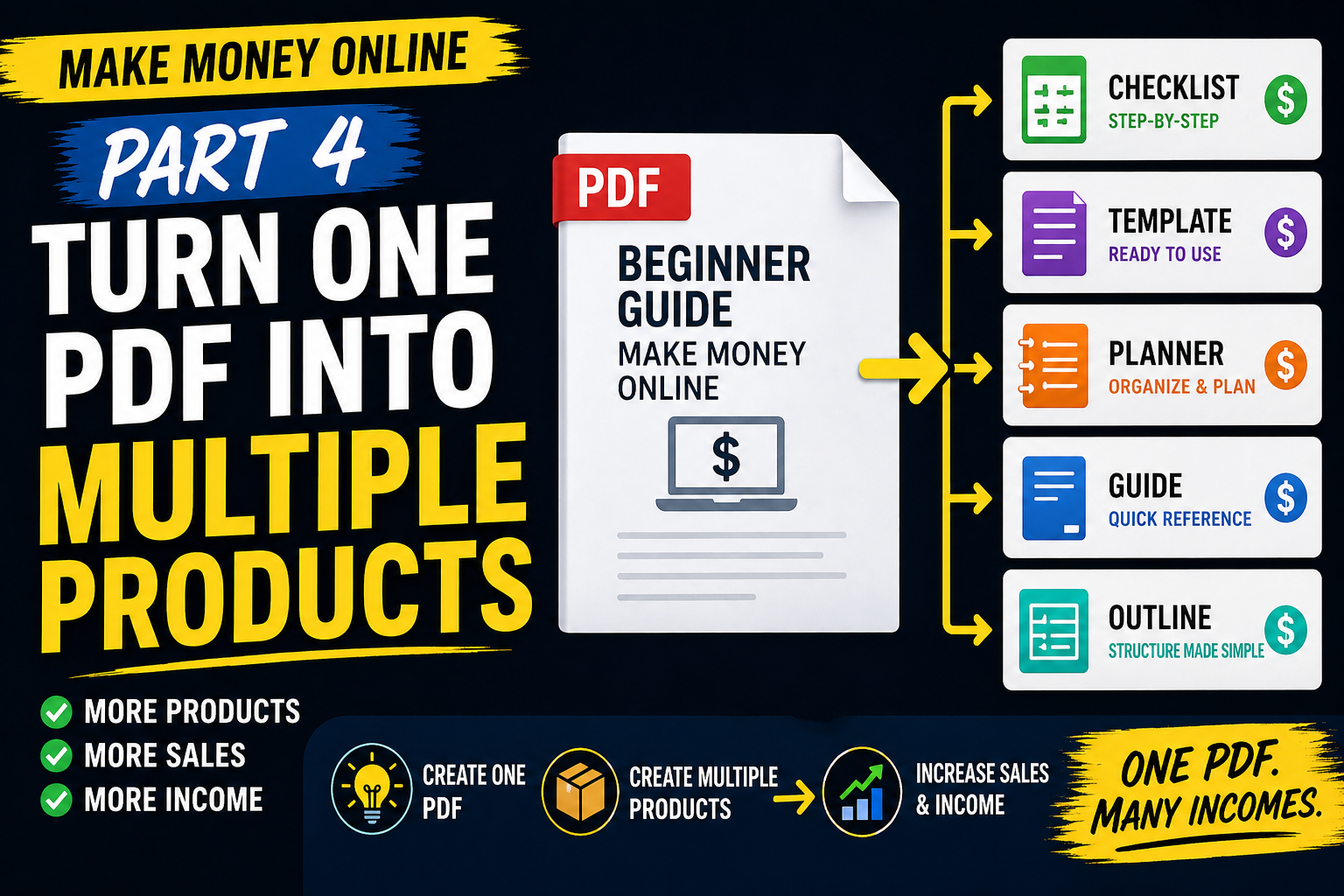
    It can be a checklist, a budget planner, a study guide, a travel preparation sheet, a simple template, or a short PDF guide.

    You can start with freelance services.

    AI can help you prepare blog drafts, product descriptions, email copy, social media captions, and basic translation support. You still need to provide quality and honesty, but AI can help you work faster.

    You can also start with content repurposing.

    Take one useful idea and turn it into different formats.
    That is one of the smartest ways to use AI.

    For example, one blog post can become:

    a YouTube Shorts script,
    a Facebook post,
    an email newsletter,
    a Pinterest description,
    a PDF checklist,
    and a future article idea.

    This is how beginners can slowly build a content system.

    The AI Era Rewards Builders

    The AI era will not reward people who only consume information.

    It will reward people who build.

    People who build articles.
    People who build websites.
    People who build digital products.
    People who build audiences.
    People who build trust.
    People who build simple systems.

    You do not need to build something huge at the beginning.

    You just need to build something small and real.

    A blog post is real.
    A PDF guide is real.
    An email list is real.
    A useful template is real.
    A published video is real.
    A small product page is real.

    These things can grow over time.

    That is the opportunity.

    AI does not guarantee success.
    But it makes building easier, faster, and cheaper.

    For ordinary people, that is a major change.

    Final Thoughts

    The AI era can feel scary.

    Some jobs will change.
    Some skills will become less valuable.
    Some industries will move faster than people expect.

    But this era is not only about loss.

    It is also about access.

    More people can now write.
    More people can now create.
    More people can now translate their ideas.
    More people can now build online assets.
    More people can now test small income systems without spending a lot of money.

    That does not mean everyone will make money with AI.

    Most people will not.

    Not because AI is useless, but because most people will not take consistent action.

    The people who benefit from AI will be the ones who use it to create, publish, improve, and repeat.

    That is why ordinary people have a new chance.

    AI does not remove the need for effort.
    It simply makes the first step easier.

    And sometimes, making the first step easier is enough to change everything.

  • How Beginners Make Money 7

    How Beginners Make Money 7

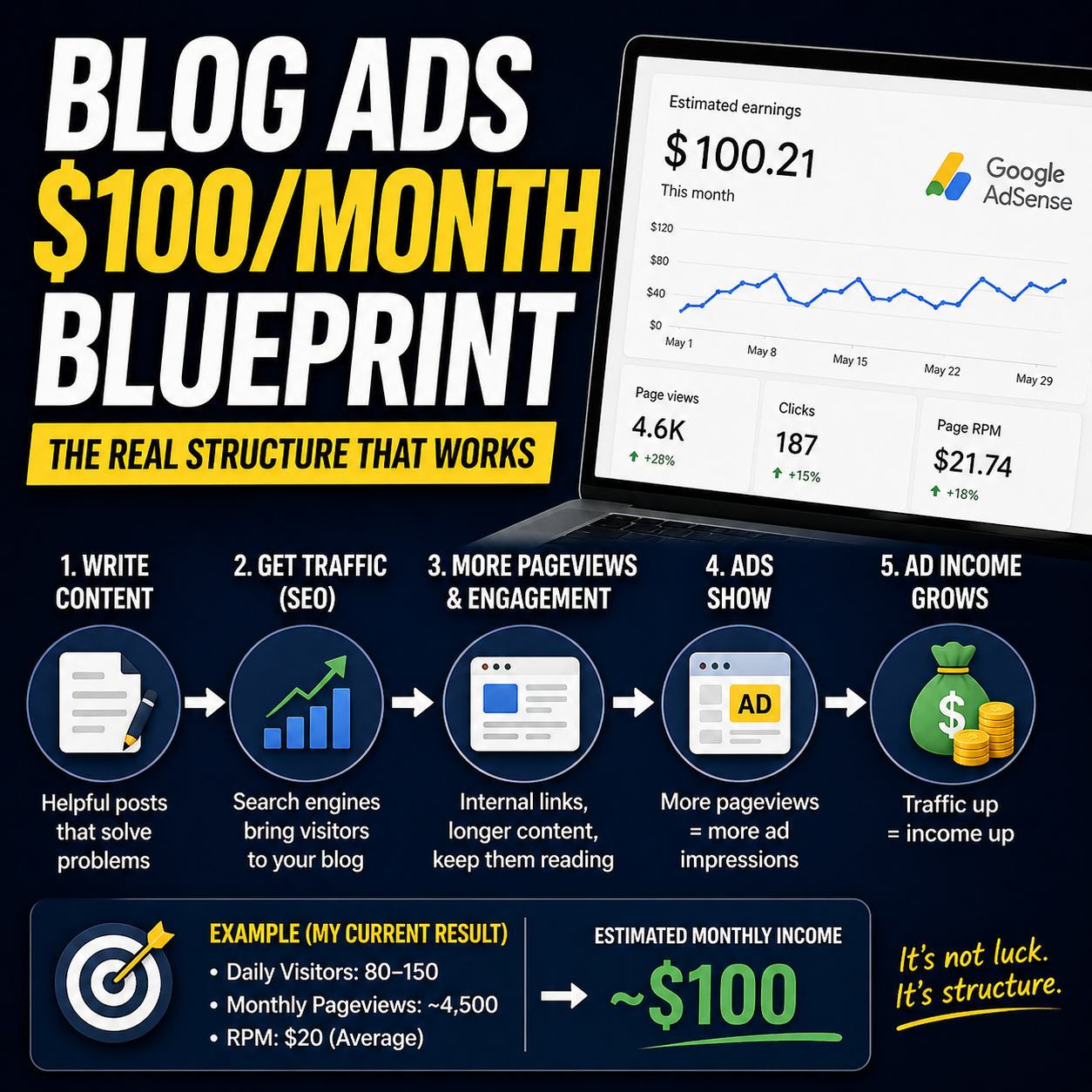
    The Real Structure of Blog Ad Income (With a Real Example)


    Most people think ads work like this:

    “Add ads → make money”

    That’s not wrong.

    But it’s completely out of order.

    Ads are not the starting point.
    They are the result
    .


    My Real Situation (Actual Example)

    Here’s what it looks like right now:

    • Monthly ad income: about $100
    • Daily visitors: around 80–150
    • Total posts: around 40–60

    The important part:

    That $100 is not because of ads.
    It’s because of traffic.


    How Ad Revenue Actually Works

    The basic formula is simple:

    Traffic × Pageviews × RPM

    RPM = revenue per 1,000 views


    Realistic Breakdown

    Let’s use a simple example:

    • 100 visitors per day
    • Each person views about 1.5 pages

    → Daily pageviews ≈ 150

    Monthly:

    → 150 × 30 = 4,500 pageviews


    If RPM is $10

    → 4,500 ÷ 1000 × 10 = $45

    If RPM is $20

    → ≈ $90

    That’s how you reach around $100/month


    The Key Insight

    Ad income is not about clicks.

    It’s mostly about:

    Pageviews × RPM


    Why RPM Changes (Very Important)

    Same traffic, different money.


    1️⃣ Audience Location

    • US traffic → high RPM
    • Southeast Asia → low RPM

    This is why English content matters


    2️⃣ Topic

    • Finance / money / business → high RPM
    • Daily life / personal stories → low RPM

    3️⃣ Time on Page

    • The longer people stay
      → more ads are shown
      → more revenue

    What Changed My Results

    At first, I just wrote posts.

    People came → read → left


    Then I changed the structure:

    • Added internal links
    • Connected related posts
    • Made content longer

    Result:

    • More pageviews
    • More ad impressions
    • More income

    What You Can Do Right Now

    1️⃣ Write longer posts

    Short posts don’t work.

    → Aim for depth, not just length


    2️⃣ Add 1–2 internal links

    Example:

    “I explained this in another post here.”

    This increases pageviews


    3️⃣ Use a series structure

    Example:

    • How to Make Money 1
    • How to Make Money 2
    • How to Make Money 3

    Natural flow → more clicks


    The Real Truth

    Ad revenue doesn’t come from
    “more clicks”

    It comes from

    making people stay longer and read more


    Affiliate vs Email vs Ads

    Affiliate
    → works with small traffic

    Email
    → creates repeat income

    Ads
    → need scale (traffic)


    Realistic Targets

    Beginner level:

    • 50 visitors/day → $20–$50
    • 100 visitors/day → $50–$150
    • 300 visitors/day → $200+ possible

    These are realistic ranges


    Final Understanding

    Earning $100/month from ads doesn’t mean
    you optimized ads well.

    It means

    you built a working structure.


    Core Idea

    Content builds traffic
    Traffic builds income


    Final Line

    Ads don’t scale first.

    Content does.

  • How Beginners Make Money 6

    How Beginners Make Money 6

    The System of Collecting Emails and Selling Again (Complete Beginner + Detailed Execution Version)


    The starting point is always the same.

    You write a post.
    People come.
    They read.
    Then they leave.

    Everyone does this.

    But there is no money.

    There is only one reason.

    You have no way to reach them again.


    What We Are Building in This Post

    One simple structure.

    A system that keeps the connection after they leave.

    When you build this, the result changes completely
    even with the same traffic.


    The Full Structure (Just follow this)

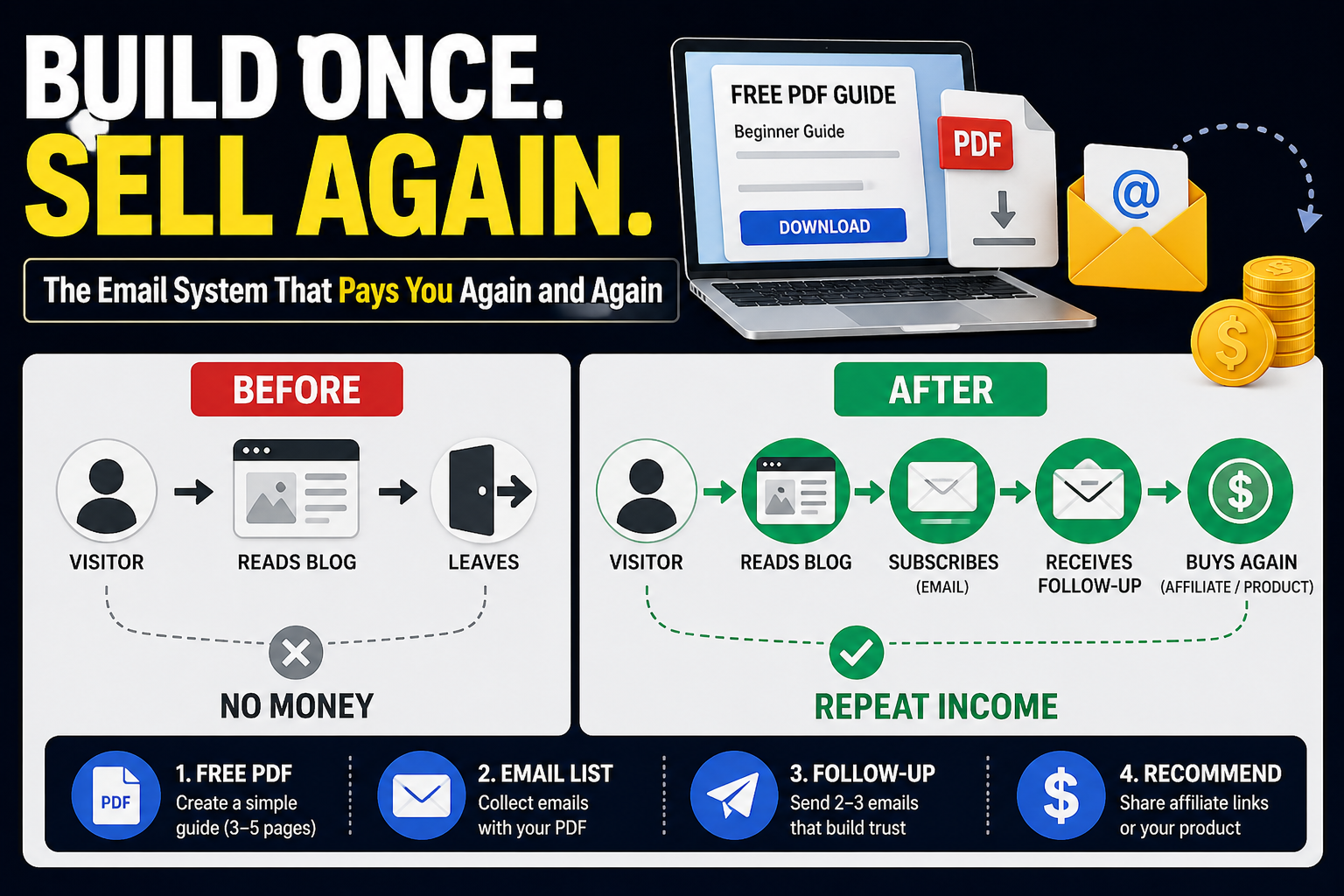
    One post
    → Free PDF
    → Email signup
    → Deliver PDF
    → Follow-up emails (2–3 days)
    → Recommend (Affiliate or product)

    It looks complex, but it’s actually simple.


    1️⃣ What Type of Post to Use

    This is where most people fail.

    You can’t attach this to any post.

    It only works with “how-to content.”

    Works

    • How to start on Fiverr
    • How to save money
    • How to make money online
    • How to create a PDF

    Doesn’t Work

    • Diary posts
    • Emotional posts
    • Random experiences

    – Reason
    People only give their email when they want more information


    2️⃣ How to Create the Free PDF (Realistic Method)

    This is where beginners get stuck.

    But it’s actually the easiest part.

    The simplest way

    Take your existing post and organize it

    Example:

    Blog post
    “How to Start on Fiverr”

    → Copy it
    → Clean up the structure
    → Add a title

    Done.


    PDF Structure (Use this as-is)

    Page 1
    Title + short intro

    Page 2
    Step 1 (Create account)

    Page 3
    Step 2 (Post your service)

    Page 4
    Step 3 (Set pricing)

    Page 5
    Checklist


    👉 Key points

    • No design needed
    • No long content
    • 3–5 pages is enough

    3️⃣ The Email Capture Sentence (Critical)

    Add this one line inside your post.

    I made a simple free PDF guide for beginners. You can download it here.

    This sentence creates clicks.


    4️⃣ Actual User Flow

    1. They read your post
    2. They see the sentence
    3. They click
    4. They enter email
    5. They receive the PDF

    👉 Still no money yet


    5️⃣ Where Money Actually Happens

    Most people stop here.

    But the real part starts now.

    Follow-up emails


    6️⃣ The 3 Email Sequence (Use as-is)

    Day 1 (Immediately)

    Subject: Here’s your guide

    Content
    Deliver the PDF
    Short message


    Day 2 (Next day)

    Subject: Most beginners fail here

    Content
    Explain a common mistake
    Mention Fiverr naturally


    Day 3 (Monetization point)

    Subject: If you want to try this

    Content
    Add your recommendation link (Affiliate)

    👉 This is where money happens


    7️⃣ Why This Works

    People don’t buy immediately.

    • First exposure → they look
    • Second exposure → they think
    • Third exposure → they act

    👉 That’s why follow-up is necessary


    8️⃣ Using This with Affiliate

    Link inside your post
    Link inside your emails

    👉 Same person, two chances


    9️⃣ Real Example Flow

    Post
    “How to Start on Fiverr”

    PDF
    “7-Day Fiverr Beginner Guide”

    Emails

    • Day 1 → Deliver
    • Day 2 → Explain mistake
    • Day 3 → Fiverr link

    Result

    • Some click immediately
    • Some click later
    • Some come back

    10️⃣ What Beginners Must Avoid

    • Creating 10 emails at once
    • Searching tools first
    • Spending time on design

    👉 None of this is necessary


    11️⃣ Minimum Setup (Realistic)

    Start with:

    • 1 post
    • 1 PDF
    • 3 emails

    Then expand gradually.


    12️⃣ The Real Difference

    Even with the same 100 visitors

    Before
    → they leave

    After
    → some stay
    → some return
    → some buy later

    👉 Completely different outcome


    Final Point

    Traffic comes once.
    Email stays.


    Final Line

    Traffic disappears.
    Email becomes an asset.

  • How Beginners Add Affiliate Income Without Creating New Content

    How Beginners Add Affiliate Income Without Creating New Content

    At some point, I realized something.

    I was already explaining everything.

    How to start on Fiverr.
    How to reuse content.
    How to create a simple PDF.

    It was all there.

    But my income wasn’t changing.


    That’s when I saw the gap

    I was helping people get started.

    They were reading, signing up, using platforms.

    And I wasn’t connected to any of it.

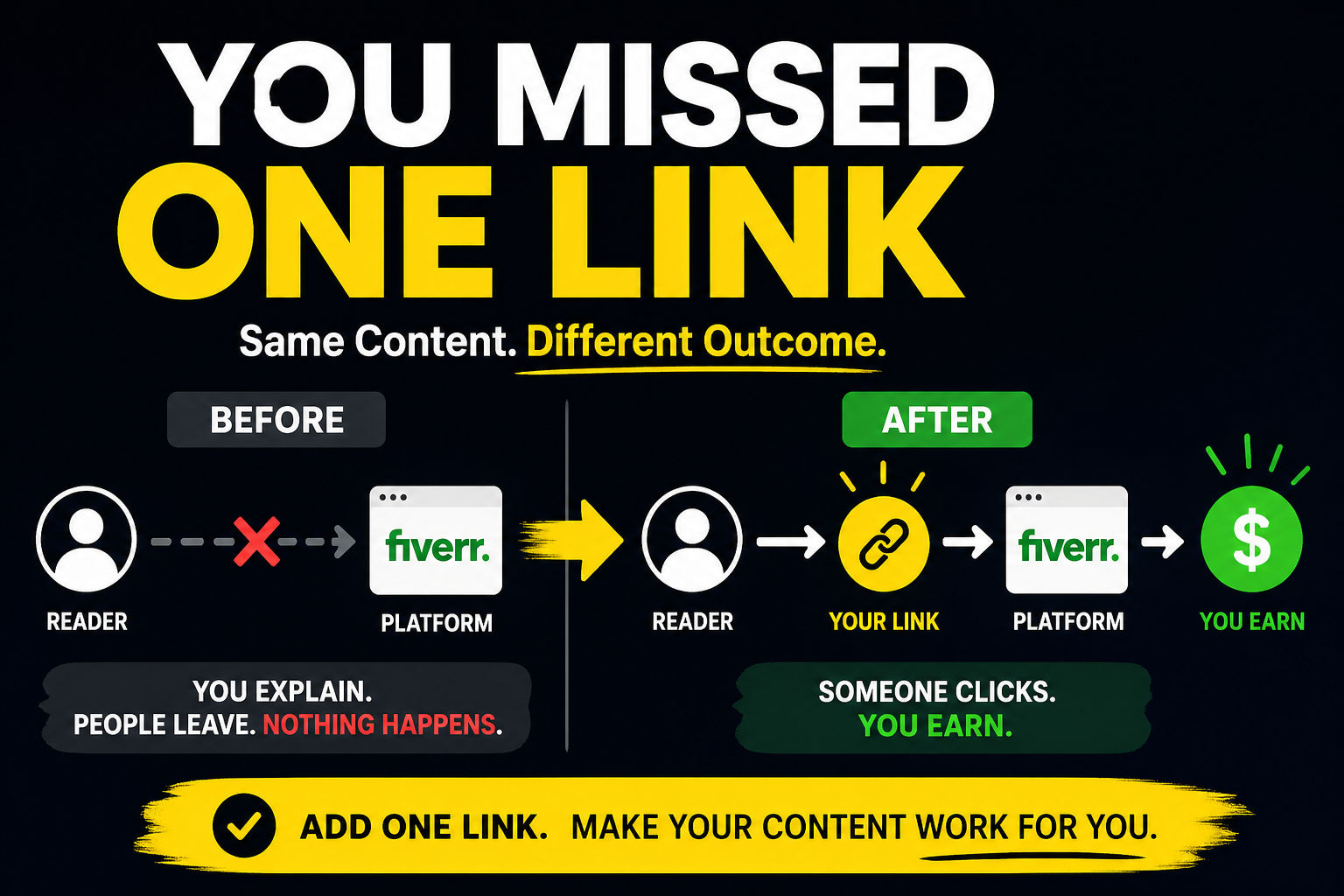
    Every time someone took action,
    I got nothing.


    So I changed one small thing

    I added one link.

    Not everywhere.

    Just where it made sense.


    What affiliate really is

    It’s simple.

    You recommend something you use.
    If someone signs up through your link,
    you earn a small commission.

    That’s it.


    Where I added it

    I didn’t try to change everything.

    I only added links where I was already explaining something.

    For example:

    When talking about Fiverr
    When explaining Gumroad
    When showing how to start something

    Just one sentence, inside the flow.


    How to actually start (step by step)

    You don’t need anything complicated.

    Here’s the simplest way to do it.

    1. Pick one platform you already talk about
      Fiverr is enough to start
    2. Search for its affiliate program
      Example: “Fiverr affiliate program”
    3. Sign up on the official page
      Usually just email, website, and basic info
    4. Get your unique link
      This is the link that tracks your referrals
    5. Go back to your existing post
      Add one sentence where it fits naturally

    What it looks like in real content

    For example:

    I used Fiverr when I started because it was simple to set up.

    Just link the word “Fiverr.”

    That’s it.

    No long explanation.
    No hard selling.


    The difference is small, but real

    Before:

    I explain → people leave → nothing happens

    After:

    I explain → someone clicks → I earn something

    Same content.

    Different outcome.


    The biggest mistake beginners make

    They try to force it.

    Too many links
    Too many mentions
    Too obvious

    It starts to feel like an ad.

    People don’t trust it.


    What actually works

    Keep it simple.

    One post, one link.

    Fiverr post → Fiverr link
    PDF post → Gumroad link

    Match the content.


    You’re not creating something new

    This is important.

    You’re not writing new content.

    You’re using what you already have
    and connecting it.

    That’s why this step is easy.


    How it changes your structure

    Before:

    Fiverr → direct income
    Content → traffic
    PDF → product

    Now:

    Affiliate → extra income on top


    One more thing (important)

    If you’re targeting a US audience, add a simple disclosure.

    You can write:

    This post may contain affiliate links. I may earn a small commission at no extra cost to you.

    That’s enough.


    Final thought

    This step is not about adding more work.

    It’s about making your existing work pay.

    You don’t need more ideas.

    You just need to connect what you already built.

  • How to Turn One PDF Into Multiple Digital Products (Beginner Strategy)

    How to Turn One PDF Into Multiple Digital Products (Beginner Strategy)

    When I first made a PDF, I thought it was the final product.

    I wrote it, organized it, uploaded it,
    and waited to see if anyone would buy it.

    At the beginning, that felt enough.

    But after a while, something became clear.

    One PDF by itself is weak.

    It might sell.
    It might not.

    And even if it does, it doesn’t build much on its own.

    That’s when I realized something important.

    A PDF shouldn’t be a single product.
    It should be the starting point.


    A PDF is not the end

    Let’s say your PDF is about something simple like:

    “How to Make Your First Money Online”

    Inside, you probably have sections like:

    • how to start on Fiverr
    • how to get your first order
    • how to reuse content
    • how to create a simple product
    • common beginner mistakes

    At first, it looks like one product.

    But it’s not.

    It’s actually a collection of smaller products.


    People don’t want long explanations

    At the beginning, it feels like more content is better.

    Longer PDFs.
    More detail.
    More explanation.

    But that’s not what most beginners are looking for.

    They don’t want to read everything.

    They want something they can use right away.

    For example, someone starting on Fiverr doesn’t always need a 30-page guide.

    They might just want:

    • example gig titles
    • short profile descriptions
    • simple message templates
    • a checklist for their first order

    That’s why templates sell.


    How to turn a PDF into templates

    The process is simple.

    Go back to your PDF and ask one question:

    “What part of this can someone copy and use immediately?”

    For example, if your PDF says:

    “It’s better to start with a simple $5 service instead of trying to sell something expensive right away.”

    That’s explanation.

    Now turn it into something usable.

    Gig title examples:

    I will rewrite your short text naturally
    I will edit your short article for clarity
    I will summarize your content into simple English
    I will do basic online research for your topic

    Now it becomes a product.


    What you can actually create

    From one PDF, you can easily create multiple small products.

    For example:

    Fiverr Gig Title Templates
    Fiverr Buyer Message Templates
    First Online Income Checklist
    Blog Post Repurposing Planner
    Simple PDF Product Outline

    You’re not creating new ideas.

    You’re reshaping what you already made.


    The actual process

    Here’s how I would do it step by step.

    Open your PDF.

    Look at the table of contents.

    Let’s say it looks like this:

    1. Starting on Fiverr
    2. Getting your first order
    3. Reusing content
    4. Creating a PDF
    5. Writing a product page

    Now turn each section into a product idea:

    Starting on Fiverr → Gig Title Template
    Getting your first order → Buyer Message Template
    Reusing content → Repurposing Planner
    Creating a PDF → PDF Outline Template
    Writing a product page → Description Template

    One PDF becomes five products.


    Tools you can use

    You don’t need anything complicated.

    For beginners, these are enough:

    Canva
    Google Docs

    If you want something simple and fast, use Google Docs.

    Write the content, format it cleanly, export as PDF.

    That’s it.

    Don’t spend too much time on design at the beginning.

    Your goal is not perfection.

    Your goal is to see if it sells.


    Pricing strategy

    Start low.

    $3 to $7 is realistic for simple templates.

    Examples:

    Fiverr Gig Title Templates — $3
    First Online Income Checklist — $5
    PDF Product Outline Template — $7

    The goal is not to maximize profit.

    The goal is to confirm that people are willing to pay.


    Where to sell

    If you’re starting from zero, keep it simple.

    Start with Gumroad.

    It’s easy to upload files.
    Easy to set up payments.
    Good for testing.

    Etsy can work later, but it requires more effort.

    So a simple path looks like this:

    Start → Gumroad
    Expand → Etsy
    Connect → Your blog


    How to write your product page

    Keep it simple.

    You don’t need a long sales page.

    Just include:

    • who it’s for
    • what problem it solves
    • what’s included
    • how to use it

    For example:

    This template is for beginners who want to start on Fiverr but don’t know what to write.

    Inside, you’ll get simple gig title examples and short message templates you can use right away.

    You don’t need experience.
    You just need a clear starting point.

    That’s enough.


    Don’t try to make one perfect product

    This is where most beginners get stuck.

    They try to make one big, perfect product.

    That takes too long.

    And often, it never gets released.

    A better approach is to create small products first.

    Test what people actually buy.

    Then improve from there.


    The difference between a PDF and a template

    A PDF explains.

    A template lets people act.

    A PDF tells you what to do.
    A template shows you exactly how to do it.

    That’s why templates are easier to sell.

    People don’t want to think.

    They want something they can use immediately.


    What I would create first

    If I had to start again, I would create these first:

    Fiverr Gig Title Template
    First Online Income Checklist
    Blog Post Repurposing Planner
    Simple PDF Outline
    Gumroad Product Description Template

    Each one connects to your content.

    That’s important.


    How to connect it to your blog

    Inside your blog posts, you can mention your templates naturally.

    For example, in a Fiverr post:

    “If you don’t know what kind of gig to create, I made a simple Fiverr gig title template for beginners.”

    Then link your product.

    In a content post:

    “If you want to turn one blog post into multiple pieces, a simple repurposing planner can make it easier.”

    Then link your product.

    In a PDF post:

    “If you don’t know how to structure your first PDF, start with a simple outline instead of a blank page.”

    Then link your product.

    No pressure. No aggressive selling.

    Just make it part of the flow.


    Final thought

    A PDF is not the final step.

    It’s the starting point.

    Inside that one file, there are multiple smaller products waiting to be created.

    You don’t need more ideas.

    You need to break down what you already made
    and turn it into something people can actually use.

    That’s how beginners expand income.

  • How Beginners Make Money Online (Part 3) — When Content Starts Paying You (PDF)

    How Beginners Make Money Online (Part 3) — When Content Starts Paying You (PDF)

    After making money on Fiverr, a thought starts to grow.

    Do I really have to keep doing this forever?

    You finish one task,
    and you’re back to zero.

    You work, you get paid.
    You stop, it stops.

    After a while, it feels limiting.


    I hit that wall too

    At first, it felt fine.

    $5
    $10
    a little more each time

    But then it became obvious.

    It’s just repetition.

    Money comes in,
    but nothing builds.


    That’s when something clicked

    I realized I was throwing everything away.

    Every task I finished
    was gone.

    Every piece of content I wrote
    was just… used once.


    So I tried something different

    I took what I already had
    and put it together.

    Simple things.

    • rewriting short text
    • fixing sentences
    • organizing ideas

    Nothing special.


    I turned it into a PDF

    Not a long one.

    Maybe 8 to 10 pages.

    But I removed everything unnecessary.

    No extra explanation.
    No filler.

    Just what someone could actually use right away.


    I didn’t expect anything

    I uploaded it to Gumroad.

    Set the price low.

    $7.

    Honestly, I didn’t think it would sell.


    Then one sale came in

    Just one.

    $7.

    Small amount.

    But it felt completely different.


    Because this time…

    I didn’t do anything.

    No new task.
    No extra work.

    And money came in.


    That’s when I understood

    This is a different system.


    Where most people get it wrong

    They think they need something big.

    Expert-level knowledge.
    A perfect product.

    So they never release anything.


    But people don’t buy perfection

    They buy clarity.

    They pay for something
    that saves them time.


    So I changed how I used content

    On the blog, I explain things.

    In the PDF, I make it actionable.

    For example:

    • Blog: this is how it works
    • PDF: do this, step by step

    That’s the difference.


    Platform is simple

    If you’re starting, keep it simple.

    Just use:

    Gumroad

    That’s enough.


    Pricing is simple too

    Start low.

    $5 to $10

    You’re not trying to maximize profit.

    You’re trying to see if it sells.


    This is where everything connects

    Now the structure looks like this:

    Fiverr → immediate income
    Content → brings attention
    PDF → ongoing income

    That’s the system.


    Why most people never get here

    They wait too long.

    They try to make it perfect.

    So they never launch.


    I did the opposite

    I made something simple.
    Put it out.
    Then improved it later.


    Final thought

    The amount doesn’t matter.

    $5
    $7

    That’s not the point.


    What actually matters

    Money came in
    from something I already made.

    That changes how you think.


    After that, everything is different

    It’s not about “can this work?”

    It’s about
    “how many times can I repeat this?”